
Free PDF At the Existentialist Café: Freedom, Being, and Apricot Cocktails with Jean-Paul Sartre, Simone de Beauvoir, Albert Camus, Martin Heidegger, Maurice Merleau-Ponty and Others, by Sarah Bakewell
Those are a few of the advantages to take when getting this At The Existentialist Café: Freedom, Being, And Apricot Cocktails With Jean-Paul Sartre, Simone De Beauvoir, Albert Camus, Martin Heidegger, Maurice Merleau-Ponty And Others, By Sarah Bakewell by online. Yet, exactly how is the way to get the soft data? It's really appropriate for you to see this page since you can get the web link web page to download and install the publication At The Existentialist Café: Freedom, Being, And Apricot Cocktails With Jean-Paul Sartre, Simone De Beauvoir, Albert Camus, Martin Heidegger, Maurice Merleau-Ponty And Others, By Sarah Bakewell Just click the web link given in this post and goes downloading. It will not take much time to obtain this publication At The Existentialist Café: Freedom, Being, And Apricot Cocktails With Jean-Paul Sartre, Simone De Beauvoir, Albert Camus, Martin Heidegger, Maurice Merleau-Ponty And Others, By Sarah Bakewell, like when you require to choose book store.
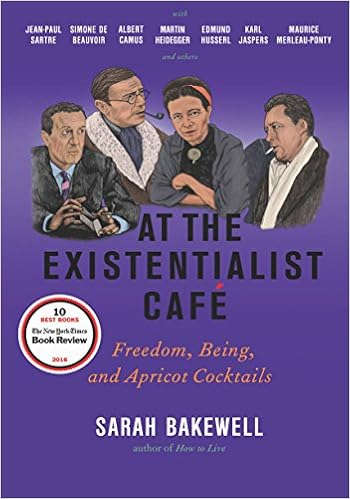
At the Existentialist Café: Freedom, Being, and Apricot Cocktails with Jean-Paul Sartre, Simone de Beauvoir, Albert Camus, Martin Heidegger, Maurice Merleau-Ponty and Others, by Sarah Bakewell

Free PDF At the Existentialist Café: Freedom, Being, and Apricot Cocktails with Jean-Paul Sartre, Simone de Beauvoir, Albert Camus, Martin Heidegger, Maurice Merleau-Ponty and Others, by Sarah Bakewell
Envision that you get such specific spectacular encounter and also understanding by only checking out a publication At The Existentialist Café: Freedom, Being, And Apricot Cocktails With Jean-Paul Sartre, Simone De Beauvoir, Albert Camus, Martin Heidegger, Maurice Merleau-Ponty And Others, By Sarah Bakewell. Just how can? It seems to be higher when an e-book can be the finest point to discover. Publications now will appear in published as well as soft documents collection. One of them is this e-book At The Existentialist Café: Freedom, Being, And Apricot Cocktails With Jean-Paul Sartre, Simone De Beauvoir, Albert Camus, Martin Heidegger, Maurice Merleau-Ponty And Others, By Sarah Bakewell It is so usual with the printed books. However, several individuals often have no area to bring guide for them; this is why they cannot read guide anywhere they want.
Feeling tough to obtain this best seller publication? Why? We presume that best seller book will always go out swiftly. So, it's not to odd when you will really feel tough to get it in guide shop, or you should bespeak At The Existentialist Café: Freedom, Being, And Apricot Cocktails With Jean-Paul Sartre, Simone De Beauvoir, Albert Camus, Martin Heidegger, Maurice Merleau-Ponty And Others, By Sarah Bakewell when you need it. Have sufficient time? Not everybody can wait on log minute to get the book. To conquer this problem, we are right here to offer you service. It is not actually tough for us. We definitely assist you by serving the listings of the brand-new best seller publications on the planet.
Don't bother! Now, in this modern period, you can get guides from several sources. No should most likely to the book stores and also walking around the city, you can find publication. Below is the website that has all superb books to accumulate. You could get it in the soft documents and utilize it to review. Of course, your tab and computer becomes excellent gadget to conserve the book. At The Existentialist Café: Freedom, Being, And Apricot Cocktails With Jean-Paul Sartre, Simone De Beauvoir, Albert Camus, Martin Heidegger, Maurice Merleau-Ponty And Others, By Sarah Bakewell is the best referral to accompany you in this time. It will aid you going along with the spare time while vacations.
Interested? Obviously, this is why, we expect you to click the link web page to see, and after that you can enjoy the book At The Existentialist Café: Freedom, Being, And Apricot Cocktails With Jean-Paul Sartre, Simone De Beauvoir, Albert Camus, Martin Heidegger, Maurice Merleau-Ponty And Others, By Sarah Bakewell downloaded and install until finished. You could conserve the soft data of this At The Existentialist Café: Freedom, Being, And Apricot Cocktails With Jean-Paul Sartre, Simone De Beauvoir, Albert Camus, Martin Heidegger, Maurice Merleau-Ponty And Others, By Sarah Bakewell in your gadget. Of course, you will bring the device everywhere, won't you? This is why, each time you have leisure, every time you could delight in reading by soft copy book At The Existentialist Café: Freedom, Being, And Apricot Cocktails With Jean-Paul Sartre, Simone De Beauvoir, Albert Camus, Martin Heidegger, Maurice Merleau-Ponty And Others, By Sarah Bakewell
Review
“The apricot cocktails in her subtitle and her sometimes breezy tone— ‘I like to imagine them in a big, busy café of the mind, probably a Parisian one’— seem to promise an undemanding, gossipy romp. Instead, [Bakewell] judges and explains the ways in which each writer responded to the moral and political crises of the 1930s and after, and her book asks demanding questions about the ways in which people think about themselves and their relations with others. She shapes her answers in the form of biographical narratives, because her central theme is that the large impersonal ideas pursued by much modern philosophy are less profound and illuminating than the varied and conflicting truths found in stories of individual lives. Those stories, in this book, include impressively lucid descriptions of what these thinkers thought and what they said in their writings and café arguments. Bakewell is often annoyed but never defeated by Heidegger’s obscurity, and some of her most exciting pages are the engaged, unsimplifying accounts she offers of complex philosophies, even ones that finally repel her…One of many persuasive surprises in Bakewell’s book is her suggestion that Heidegger’s prose sometimes resembles Gertrude Stein’s in its deliberate linguistic strangeness, a resemblance that goes deeper than style…An unspoken theme of Bakewell’s book is the variety of ways in which academic philosophy can be distorted by power relations. Some of her characters, notably Merleau-Ponty, were immune to the temptations that came with the status of European professorship. Others, like Husserl and Heidegger, demanded obeisance… Bakewell has a special affection for philosophers who stayed free of the academy, especially Sartre and Beauvoir…Sarah Bakewell’s previous book was an engaging biography of Montaigne that was also a subtle exposition of Montaigne’s writings. Its audacious title was How to Live, and her new book deserves to be read as a further study in the same enlivening theme.”--The New York Times Book Review“At the Existentialist Café is a bracingly fresh look at once-antiquated ideas and the milieu in which they flourished. Ms. Bakewell’s approach is enticing and unusual: She is not an omniscient author acting as critic, biographer or tour guide. This book is full of winning small details. Some may find the description of Camus as ‘a simple, cheerful soul,’ as surprising as Sartre’s apparently charming Donald Duck imitation… ‘When reading Sartre on freedom, Beauvoir on the subtle mechanisms of oppression, Kierkegaard on anxiety, Camus on rebellion, Heidegger on technology or Merleau-Ponty on cognitive science,’ Ms. Bakewell writes, ‘one sometimes feels one is reading the latest news.’”—Janet Maslin, The New York Times“Ms. Bakewell’s jaunty, colloquial style very successfully brought the ideas of Michel de Montaigne to a wide and general audience in her best-selling How to Live. The existentialists and their subtle differences from the phenomenologists in the context of World War II and its aftermath are a much greater challenge, which she meets with equal elan." —The Wall Street Journal“This lively history of the existentialist movement makes a strong, if sometimes disorienting, case for the inextricability of philosophy and biography, embedding dense concepts—such as ‘being,’ ‘nothingness,’ and ‘bad faith’—in the colorful lives and milieus of those who debated them. Though the book is in many ways a group study, dotted with cameo appearances by Albert Camus, Simone de Beauvoir, Maurice Merleau-Ponty, and others, it focusses on Heidegger and Sartre. Heidegger appears as oracular, hermetic, and Nazi-tainted; Sartre as intellectually promiscuous and Soviet-sympathizing. Their divergent characters and checkered reputations lend credence to Bakewell’s view that ‘ideas are interesting, but people are vastly more so.’” —The New Yorker“Brisk and perceptive…A fresh, invigorating look into complex minds and a unique time and place.” —Kirkus Reviews (starred review)"Bakewell brilliantly explains 20th-century existentialism through the extraordinary careers of the philosophers who devoted their lives and work to 'the task of responsible alertness' and 'questions of human identity, purpose, and freedom.' Through vivid characterizations and a clear distillation of dense philosophical concepts, Bakewell embeds the story of existentialism in the 'story of a whole European century,' dramatizing its central debates of authenticity, rebellion, freedom, and responsibility." —Publishers Weekly (starred review)“Bakewell follows her celebrated study of Montaigne…with a lively appraisal of existentialism and its leading thinkers…With coverage of friendship, travel, argument, tragedy, drugs, Paris, and, of course, lots of sex, Bakewell’s biographical approach pays off… The result is an engaging story about a group of passionate thinkers, and a reminder of their continued relevance.” —Booklist (starred review)“Sweeping and dazzlingly rich...This wonderfully readable account of one of the 20th century’s major intellectual movements offers a cornucopia of biographical detail and insights that show its relevance for our own time.”—BookPage"Tremendous...rigorous and clarifying...Highly recommended for anyone who thinks." —Library Journal (starred review)“In her instructive and entertaining study of these thinkers and their hangers-on, Sarah Bakewell… credits the existentialist movement, broadly defined, with providing inspiration to feminism, gay rights, anti-racism, anti-colonialism and other radical causes. A few cocktails can, it seems, lead to unexpected things.” —The Economist“At the Existentialist Cafe: Freedom, Being, and Apricot Cocktails may come dressed in a seductive title, but Sarah Bakewell’s book about the people and ideas behind the existentialist movement is both breezy and brainy. Bakewell demonstrated her ability to plumb big ideas for real-life relevance in How to Live, her 2010 biography of Michel de Montaigne…She brings the same lively intelligence to her latest work. Here Bakewell traces a fascinating sort of philosophical relay of ever-mutating concepts — perception, being, authenticity, responsibility — against a backdrop of political upheavals. Her book explores the roots of existentialism and its impact in the 20th century in much the way Carl Schorske’s Pulitzer Prize-winning Fin de Siècle Vienna explored the birth of modern art and culture in late-19th-century Vienna… [and] lucidly breaks down dense philosophical texts while avoiding the pitfalls of over-simplification… At the Existentialist Cafe is most riveting in its report of the World War II years. During the occupation, existentialists — who believed above all in freedom and responsibility — were engaged and committed to the Resistance in their actions and their literature… Among a panoply of riches, Bakewell offers fascinating anecdotes, including the heroics involved in saving Husserl’s papers during the war. Her chronicle of many lives cut short reveals an astonishing number of fatal heart attacks among existentialists — including Boris Vian, Richard Wright, Merleau-Ponty and Arendt — leaving readers to wonder if philosophy isn’t a heartbreaking enterprise after all. Bakewell surely doesn’t think so. ‘Even when existentialists reached too far, wrote too much, revised too little, made grandiose claims, or otherwise disgraced themselves, it must be said that they remained in touch with the density of life, and that they asked the important questions. Give me that any day,’ she declares in this rousing call to robust intellectual engagement.” “These days, the word 'existentialism' brings to mind black turtlenecks, French cigarettes, and a distinctly European sense of despair. But as Sarah Bakewell describes them in this vivid, vital group biography, existentialists like Jean Paul Sartre, Simone de Beauvior, and Albert Camus were courageous free thinkers in an age of fascism, totalitarianism, and conformity.”—The Boston Globe“A vivid and warmly engaging intellectual history.”—The Los Angeles Times “Bakewell has made weighty, complex philosophical ideas feel exhilarating — for that she should be praised, and read.”—The San Francisco Chronicle“Although biography provides the narrative momentum of At the Existentialist Café, much of the meat comes from the philosophy…Bakewell has a knack for crystallising key ideas by identifying choice original quotations and combining them with her own words…Perhaps the aphorism that best captures the book is one of Bakewell’s own: 'Thinking should be generous and have a good appetite.' Her hunger is infectious.”—Financial Times“[At the Existentialist Café] offers fascinating insights into the cultural impact of existentialism on the English-speaking world…Existentialism, in all its incarnations, is really about making choices. How to live? How to be free? How to be an 'authentic' human being? In her summing-up, Bakewell makes the case that these questions remain as important today as they ever were.” —The Guardian (US)“Bakewell writes with a sunny disposition and light touch…She combines confident handling of difficult philosophical concepts with a highly enjoyable writing style. I can’t think of a better introduction to modern intellectual history.”—Newsday “Bakewell’s How to Live [was] a remarkably erudite and accessible study of the life of Montaigne…At first skeptical, I was soon warmed over by the author’s preternaturally smooth style. At the Existentialist Café does precisely the same for Jean-Paul Sartre, Simone de Beauvoir, Albert Camus, and Martin Heidegger.” —Flavorwire“This tender, incisive and fair account of the existentialists ends with their successive deaths, leaving me with the same sense of nostalgia and loss as one feels after reading a great epic novel.” —The Telegraph“[At] the Existentialist Café is packed with out-of-the-way knowledge and has a cast of weird characters such as only a gathering of philosophers could supply. It is written with affection. Even the horrible Heidegger is seen as human in his absurdity.” —The Sunday Times“[E]ngaging and wide-ranging.”—Prospect Magazine“[At the Existentialist Café is] a wonderfully readable combination of biography, philosophy, history, cultural analysis and personal reflection.” —The Independent“At the Existentialist Cafe will prove to be one of the best books on philosophy you will read this year.”—The Wichita Eagle“[An] invigorating book.”—Tablet "Irresistible." —Buffalo News"Don’t let the breezy title put you off. At the Existentialist Café, Sarah Bakewell’s group portrait of Husserl, Heidegger, Sartre, Beauvoir, and the other 'Continental' philosophers who flourished before and after World War II, is a work of deep intelligence and sympathy, reminding us how exciting those thinkers can be. And it’s a page-turner. I was so sorry to finish the last chapter that I almost—almost—ran over to the Strand to see what they had by Merleau-Ponty." —Lorin Stein, Paris Review Daily“At the Existentialist Café: Freedom, Being, and Apricot Cocktails combines the exhilaration of initial discovery with the more considered evaluations of a mature thinker. The result is a warm and challenging work of intellectual history that retains something of existentialism’s glamor without ever sacrificing its vigorous interrogation. It also re-centers existentialism as a viable method of philosophically engaging with contemporaneity. Even if the context has shifted slightly, the question it asks remains just as relevant now as in the post-war years: what shall we make of a shattered world?” —The Brooklyn Rail"It's not often that you miss your bus stop because you're so engrossed in reading a book about existentialism, but I did exactly that while immersed in Sarah Bakewell's At the Existentialist Café. The story of Sartre, Beauvoir, Camus, Heidegger et al is strange, fun and compelling reading. If it doesn't win awards, I will eat my proof copy."—Katy Guest, The Independent on Sunday
Read more
About the Author
Sarah Bakewell was a bookseller and a curator of early printed books at the Wellcome Library before publishing her highly acclaimed biographies The Smart, The English Dane, and the best-selling How to Live: A Life of Montaigne, which won the National Book Critics Circle Award for Biography. In addition to writing, she now teaches in the Masters of Studies in Creative Writing at Kellogg College, University of Oxford. She lives in London.
Read more
Product details
Hardcover: 448 pages
Publisher: Other Press; 1st edition (March 1, 2016)
Language: English
ISBN-10: 1590514882
ISBN-13: 978-1590514887
Product Dimensions:
6.2 x 1.4 x 9.3 inches
Shipping Weight: 1.5 pounds (View shipping rates and policies)
Average Customer Review:
4.5 out of 5 stars
303 customer reviews
Amazon Best Sellers Rank:
#41,341 in Books (See Top 100 in Books)
In the opening scene of At the Existentialist Café, philosopher Raymond Aron says to his friend Jean-Paul Sartre, “If you are a phenomenologist you can talk about this cocktail and make philosophy out of itâ€. After reading this book, I say, “If you are Sarah Bakewell, you can take existentialism and make sense out of it.â€The existentialist themes of freedom, political activism, and “authentic being†became watchwords of the middle and late 20th century. When I first encountered existentialist writing, I was simultaneously entranced, repelled, and confused. (Bakewell tells us that even Beauvoir said that when she and Sartre tried to read Heidegger’s lecture “What is Metaphysics?â€, “we could not understand a word of it.â€) Not only did the existentialists not always agree with each other, sometimes they did not even agree with themselves. National Book Critics’ Circle Award winner Bakewell’s clear writing and carefully researched portrayal of the context in which existentialism developed gave me a much better understanding of this school of thought that both influenced and reflected most of the last century.In addition to a providing a lucid discussion of the various expressions of existentialist philosophy, Bakewell really brings to life the thinkers behind it. Names like Husserl, Heidegger, Beauvoir and lesser known figures in their milieu became real people. One of my favorite chapters introduced me to “the dancing philosopher†Merleau-Ponty, whose personality was as engaging as his thinking. Unlike Beauvoir and Sartre, “journalists did not quiz him about his sex life---which is a shame, as they would have dug up some interesting stories.†Photos throughout the book were a nice complement to the narrative. My favorite, which is on the last page of the book, shows Sartre and Beauvoir together laughing and obviously enjoying life, a stark contrast to the angst usually associated with the existentialists.The existentialists’ lives spanned almost the entire twentieth century: World War I, the Great Depression, World War II, and the Cold War with its threat of nuclear attack. They were profoundly affected by what was happening around them and to them. Bakewell does an excellent job of showing how, as Merleau-Ponty put it, both their lives and ideas were “contingent…---at the mercy of historical events and other changes they could not controlâ€. It was heart-wrenching to envision Edmund Husserl fleeing the German persecution of the Jews while his former friend and student served as a leading apologist for the Nazis.In the final chapter, Bakewell lets the reader in on some of her own feelings about existentialism and the existentialist figures, from her original fascination thirty years ago to how her feelings shifted in the course of writing the book. It was an excellent summation that gave me more insight into the author as well as the philosophy and people she writes about.I’m not sure whether to call At the Existentialist Café biography, history, or philosophy. What I will definitely call it is worth your time. This book could be a contender for another major award.
It is well known that technology has reached the point where we are often better known by the almighty computer than we know ourselves. Although my Amazon Vine queue sometimes mystifies me (WHY as a 76-year-old woman whose youngest grandchild is in high school am I continuously being offered baby products?), it turns out that Sarah Bakewell’s “At the Existentialist Café†is a tremendous gift to my reading experience. It didn’t take me long to realize why I was offered this book, despite my previous total lack of involvement with any formal study of philosophy. I recently purchased several books relating to Edith Stone, the Jewish existential philosopher and student of Husserl, who converted to Catholicism; became a nun; was martyred at Auschwitz; and recently canonized. Indeed, Bakewell’s book, much to my delight, more or less begins with a discussion of the phenomenological approach to philosophy of Husserl, and cites Stein’s dissertation on Empathy, which is one of the books I purchased.In any event, Bakewell’s book is a magnificently crafted narrative that really defies any narrow classification. Yes, it deals with modern philosophical trends such as Phenomenology, Existentialism and Transcendentalism going all the way back to Kierkegaard and Nietzsche. In addition, it is a historical description of the circumstances surrounding the development of philosophy and its interaction with the political scene before, during and after the rise of Nazism and WWII. Furthermore, it is a series of wonderfully insightful biographical vignettes of the major authors of that era, with special focus on Sartre and Beauvoir.A book with this scope could turn out to be deadly dull, incredibly complex, or hopelessly academic. It is none of these things. It almost reads like a novel, and smoothly interweaves both factual and analytical material, bringing the various individuals who are highlighted to vivid life. There are excellent illustrations, scattered throughout the text. Although they are not captioned in the “uncorrected proof†copy provided for review, they fit so well with the narrative that it is easy to see how they connect. Again due to the uncorrected proof format, the extensive notes provided at the end are not annotated in the text, which made it easy for me as a non-scholarly reader to simply read through with ease, but with confidence that if I wanted to check any sources, that information IS available. Finally, Bakewell provided a multi-page “cast of characters†which gave thumbnail bio data on everyone mentioned in the book, which I consider extremely valuable. I consider myself both blessed, and extremely enlightened; this book is a treasure.
At the Existentialist Café: Freedom, Being, and Apricot Cocktails with Jean-Paul Sartre, Simone de Beauvoir, Albert Camus, Martin Heidegger, Maurice Merleau-Ponty and Others, by Sarah Bakewell PDF
At the Existentialist Café: Freedom, Being, and Apricot Cocktails with Jean-Paul Sartre, Simone de Beauvoir, Albert Camus, Martin Heidegger, Maurice Merleau-Ponty and Others, by Sarah Bakewell EPub
At the Existentialist Café: Freedom, Being, and Apricot Cocktails with Jean-Paul Sartre, Simone de Beauvoir, Albert Camus, Martin Heidegger, Maurice Merleau-Ponty and Others, by Sarah Bakewell Doc
At the Existentialist Café: Freedom, Being, and Apricot Cocktails with Jean-Paul Sartre, Simone de Beauvoir, Albert Camus, Martin Heidegger, Maurice Merleau-Ponty and Others, by Sarah Bakewell iBooks
At the Existentialist Café: Freedom, Being, and Apricot Cocktails with Jean-Paul Sartre, Simone de Beauvoir, Albert Camus, Martin Heidegger, Maurice Merleau-Ponty and Others, by Sarah Bakewell rtf
At the Existentialist Café: Freedom, Being, and Apricot Cocktails with Jean-Paul Sartre, Simone de Beauvoir, Albert Camus, Martin Heidegger, Maurice Merleau-Ponty and Others, by Sarah Bakewell Mobipocket
At the Existentialist Café: Freedom, Being, and Apricot Cocktails with Jean-Paul Sartre, Simone de Beauvoir, Albert Camus, Martin Heidegger, Maurice Merleau-Ponty and Others, by Sarah Bakewell Kindle