
Download Ebook How the Economy Works: Confidence, Crashes and Self-Fulfilling Prophecies
After getting some reasons of how this How The Economy Works: Confidence, Crashes And Self-Fulfilling Prophecies, you should feel that it is extremely correct for you. However, when you have no concept concerning this book, it will be better for you to attempt reading this publication. After reading page by page in just your leisure, you can see how this book will work for your life.
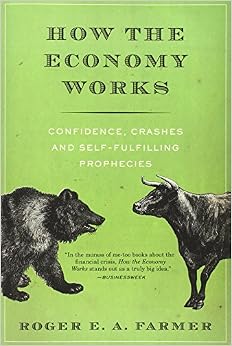
How the Economy Works: Confidence, Crashes and Self-Fulfilling Prophecies

Download Ebook How the Economy Works: Confidence, Crashes and Self-Fulfilling Prophecies
Come again, guide that is not just comes to be the device or fashion yet additionally a real pal. What sort of friend? When you have no pals in the lonesome when you require something accompanying you when during the night prior to resting, when you feel so bored when awaiting the checklists, a publication can feature you as a real buddy. And also among truth good friends to really recommend in this site will certainly be the How The Economy Works: Confidence, Crashes And Self-Fulfilling Prophecies
Knowing several publications may not confirm you to be a much better individual. However knowing and also reading books will make you really feel much better. Schedule at the tool to get to effective is wise words that are uttered by some individuals. Do you think it? Possibly, just couple of individuals that such as the words and also believe in those words. Nevertheless, you must think it because book can bring you better thing as intended as the goals of analysis as well as publications. As the How The Economy Works: Confidence, Crashes And Self-Fulfilling Prophecies that we serve, this is not type of nonsense book that will certainly influence nothing.
The book is a book that can help you discovering the fact in doing this life. Moreover, the suggested How The Economy Works: Confidence, Crashes And Self-Fulfilling Prophecies is additionally composed by the expert writer. Every word that is given will certainly not burden you to think about. The way you love reading might be started by another publication. However, the way you need to read publication again and again can be begun with this favored publication. As reference this book likewise serves a much better concept of the best ways to attract individuals to review.
And currently, your chance is to obtain this publication as soon as possible. By seeing this web page, you can in the connect to go straight to the book. As well as, get it to become one part of this most recent publication. Making sure, this book is truly recommended for analysis. Whether you are not followers of the writer or the topic with this book, there is no fault to review it. How The Economy Works: Confidence, Crashes And Self-Fulfilling Prophecies will certainly be actually ideal to review now.
Review
"Roger Farmer offers a new diagnosis for what ails the economy. His clear and forceful writing encourages policymakers and the public to think out of the box and reach for new solutions."--Greg Mankiw, Professor and Chairman of the Economics Department at Harvard University"In the morass of me-too books about the financial crisis, How the Economy Works stands out as a truly big idea." --BusinessWeek "Bringing new research to life in guiding policy in the aftermath of the financial crisis, Roger Farmer takes the economic ball up the middle between Hayek and Keynes. With an emphasis on swings in confidence and wealth, Farmer's criticisms of fiscal stimulus and interesting prescriptions for monetary policy should be essential reading for anyone trying to understand what happened, especially for economists and policymakers focused on recovery. Nonspecialists will find the book full of fascinating stories; economists will see some surprising new twists."--Glenn Hubbard, Dean of the Columbia Business School, Columbia University, former Chairman of the Council of Economic Advisers"This is an important policy proposal from a top thinker. Farmer balances the traditions of Hayek and Keynes to formulate a new way to stabilize the economy-and to solidify society's confidence about its future prospects. He returns us to first principles and builds a clear, succinct argument in language that is easy to follow. No policymakers are rushing to adopt Farmer's approach; but the same was true for Keynes in the 1930s. Let's hope we don't need to experience another Great Depression before our economic leaders are seriously willing to rethink everything."--Simon Johnson, Ronald A. Kurtz (1954) Professor of Entrepreneurship at the MIT Sloan School of Management, former chief economist at the International Monetary Fund"Farmer provides an excellent discussion of what went wrong with modern economics in the run up to the recent crisis. And to deal with the effects of the financial crisis, boosting investment and employment in the short and the long run, he provides a policy plan to induce a rapid and sustainable recovery through direct intervention in the stock market. If he is right it would improve things quickly, and if he is wrong the tax payer ends up receiving dividends through the Central Bank investment portfolio. It is worth a try."--Ray Barrell, Director of Macroeconomic Research and Forecasting, National Institute of Economic and Social Research, UK "Readers with a serious interest in this subject will find this timely book informative..."--Publishers Weekly "Readers who lack the time or interest to sift through in-depth explanations of economic theories will gain from Farmer's brief explanations of standard economic theories and biographical sketches of major thinkers."--Library Journal
Read more
About the Author
ROGER E. A. FARMER is a 2013 Senior Houblon Norman Fellow at the Bank of England. He is a Distinguished Professor of Economics at UCLA and served as Department Chair from July 2008 through December 2012. The author of six books and numerous academic journal articles, he is a Fellow of the Econometric Society, a Research Associate of the National Bureau of Economic Research and a Research Fellow of the Centre for Economic Policy Research. Professor Farmer has served, and continues to serve, as a consultant to central banks around the world. He is a regular contributor to the Financial Times, Project Syndicate and VoxEU. He is a co-winner of the 2013 Maurice Allais Prize in Economic Science for his work on the inefficiency of financial markets; and in 2000, he received the University of Helsinki medal in recognition of his work on self-fulfilling prophecies.
Read more
Product details
Paperback: 216 pages
Publisher: Oxford University Press; Reprint edition (April 1, 2014)
Language: English
ISBN-10: 0199360308
ISBN-13: 978-0199360307
Product Dimensions:
8.2 x 0.6 x 5.5 inches
Shipping Weight: 11.4 ounces (View shipping rates and policies)
Average Customer Review:
3.6 out of 5 stars
41 customer reviews
Amazon Best Sellers Rank:
#549,589 in Books (See Top 100 in Books)
A very informative read. The author explains how the economy works, provides insight on how the economy misfires, informs you how this is combatted, then gives his own theoretical solution to prevent future economic meltdowns. He also mentions the major contributors of economic thought and how they shape our understanding of the economic engine today. A very good read.
Farmer's research is really interesting, but this book is a failed attempt to translate that research to a popular audience. He has interesting ideas that macroeconomists should take seriously, but this book is a waste of time for professionals and non-professionals alike. Hopefully someone will popularize his work since Farmer truly is the heir to Keynes.
This item arrived very quickly. The item arrived exactly as I expected. Thank you very much for the timely fulfillment.
America and the world are in quite a rough spot economically right now. It is certainly not the worst the world has seen, and it is likely to get better, but it is possibly the worst most of us can remember. In the face of troubles like this, it would be helpful to understand the economic forces at work. Author Farmer, though, goes beyond that. He feels (rightly) that it is our duty as responsible citizens to understand the combination of forces at work so that we can respond correctly and choose wisely at the ballot box.Farmer is a Keynesian. Don't worry if you don't know the difference, as the author explains in clear language what the difference between classical "free market" economists and John Maynard Keynes is. His explanation, summarized, is that classical economists believe that free markets will "find equilibrium" or that they will correct themselves eventually, whereas Keynes felt that it was the responsibility of governments to push national economies one way or another to prevent or lessen the wild gyrations a free market can sometimes develop, and which often are the changes which hurt individuals.Farmer also explains the role of the Federal Reserve Bank, and it seems that his opinion is that the Fed gets too much credit when things are good and too much blame when things are bad. The Fed, he correctly points out, has few tools to control the economy at their disposal, and the tools that they have are weak. Farmer argues that this is not a bad thing, as the Fed is not the proper entity to be affecting significant change anyway; that is the role of elected and accountable governments.The book is short, clearly written and fairly easy to understand. It gives a review of the major schools of economic thought, and argues clearly for Keynes over classical economics. You can learn a lot in a few pages, but be sure to read a few more books on Economics to get the full perspective and decide for yourself which you believe.
This thought-provoking book provides a historical characterization of the major influences that two schools of thought, called the Classicists and the Keynesians, have had on macroeconomic thinking, and their contributions to the perceived roles and tools available to governments and regulators in times of economic fluctuations, with special attention to how these entities should grapple with unemployment.According to the Classicists, an unregulated capitalist economy is a self-correcting system; unemployment results from a temporary imbalance in free-market forces that will self-heal without government intervention.During the Great Depression, however, unemployment was extraordinarily high for an extended period of time, prompting Maynard Keynes to assert that high unemployment rates over an extended period of time was incompatible with an efficient markets theory which implied that whatever the source of imbalance, a self-correcting economy will quickly return to full employment.Keynes proposed a different explanation of what caused the depression. According to him, a spontaneous fall in investors' confidence about the future caused a stock market crash and a drying out of private investment expenditures, which in turn caused unemployment rates to remain high for a prolonged period of time. Keynes' proposed remedy for such a situation was: if private investment expenditure is too low, it must be replaced by government investment expenditure. Thus was born the concept of deficit spending in support of stimulating an economy.Although the Keynesian fiscal policies adopted by the Franklin D. Roosevelt's administration were deemed successful in restoring full employment, post-Roosevelt / post-World War II experiments with deficit spending were less successful. During the 1960's, the United States became entangled in an unpopular Vietnam War that was difficult to finance by raising taxes. The government resorted instead to ever larger increases in government borrowing to pay for military expenditures.Keynesian theory predicted that these deficits should have led first to full employment, and only then to inflation. But high unemployment and inflation rates co-occurred (a condition named "stagflation") during the 1970's, and this phenomenon discredited Keynesian theory, which in turn led to the resurgence of the Classicist theory, until we find ourselves in the present day, trying to divine how to dig ourselves out of yet another deep recession and many are asking: To "Keynes" or not to "Keynes", that is the question.Or is it? Do we have to let the pendulum swing back to Keynes? What are the stakes? Professor Farmer shares with us his opinions of what caused the current recession, what parts of the Classicist and Keynesian theories integrate with his views and how his views improve on them, what our government and regulators should and shouldn't do and why. In the last chapter in particular, he introduces a relatively new tool that he thinks the U.S. Federal Reserves should use to help combat economic fluctuations.The book is not exactly an easy read, even though the author had meant it to be more accessible to non-economists than academically-oriented books. It is not jargon-free, but the author does a pretty good job explaining terms, concepts, and theories. The biggest problem I had with the book was this: the author tried very hard to cover a lot of stuff (e.g., various tweaks to both the Classicist and Keynesian theories) in a short amount of space so he tended to offer only brief explanations and to go over stuff in a fast pace; for the uninitiated, this can actually be a little bit overwhelming. It can also be unsatisfying, because if you want to dig deeper, you either need to consult other sources for general economic terms, or for concepts / ideas particular to his own views, you may have to wait for his * OTHER * book to come out, and hopefully, THAT book will offer the kind of details you need or desire.
I've always wanted to read a highly condensed version of economic thought, and here it is. At the end of this, I think it's fair to say one will understand the philosophical differences underlying Keynesian and classical economics approaches, particularly as these relate to the issue of unemployment. Current economic debates become clearer with these understandings. I've never cared much for mathematical economics, and this book bypasses all that.It's so condensed that it really requires very careful reading. One of the 2 star raters stated it's not really an introduction to economic thought. I have to agree somewhat; if one wishes to appreciate this book, one already needs to have fairly good economics background. ¾ of the book is about history of economics thought, and the remaining ¼ contain some of author's view. So, you can imagine how condense--essentially a tiny paperback covering the history of economic thought and being able to interject the author's view.I have to give it a 5 star because by being condensed, it values the reader's times
How the Economy Works: Confidence, Crashes and Self-Fulfilling Prophecies PDF
How the Economy Works: Confidence, Crashes and Self-Fulfilling Prophecies EPub
How the Economy Works: Confidence, Crashes and Self-Fulfilling Prophecies Doc
How the Economy Works: Confidence, Crashes and Self-Fulfilling Prophecies iBooks
How the Economy Works: Confidence, Crashes and Self-Fulfilling Prophecies rtf
How the Economy Works: Confidence, Crashes and Self-Fulfilling Prophecies Mobipocket
How the Economy Works: Confidence, Crashes and Self-Fulfilling Prophecies Kindle