
Free Ebook The Church of Scientology: A History of a New Religion, by Hugh B. Urban
ever fret if this The Church Of Scientology: A History Of A New Religion, By Hugh B. Urban is not your much-loved book. We are below not only giving the only book. You could search the title in this site as well as discover the hundreds collections of the books. You recognize, the books that we give are originating from all libraries and publisher in the world. You could pick title to title to acquire the books to review. But formerly, juts attempt to get this book since it's very appealing. Try it and also comment!
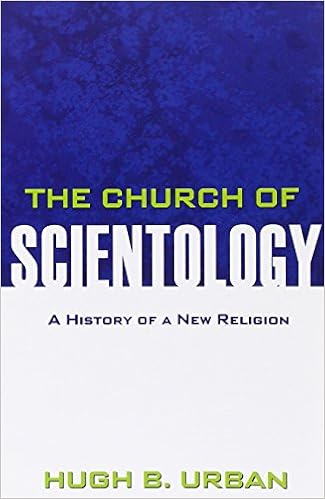
The Church of Scientology: A History of a New Religion, by Hugh B. Urban

Free Ebook The Church of Scientology: A History of a New Religion, by Hugh B. Urban
When someone believes that reading is a crucial task to do for the human life, some other may think about just how analysis will certainly be so monotonous. It's usual. When many individuals like to choose going someplace and chatting with their good friends, some individuals favor to g to guide shops as well as hunt for the new publication released. Exactly how if you do not have adequate time to go guide store?
If you still feel puzzled to choose guide and also you have no idea regarding what sort of book, you can think of The Church Of Scientology: A History Of A New Religion, By Hugh B. Urban Why should be it? When you are searching a publication to be read, you will check out the cover layout initially, will not you? It will likewise be the method of you to be interested to see the title. The title of this publication is additionally so intriguing to review. From the title, you may be interested to check out the content.
And currently, after knowing the writer, you can additionally get over that the book is suggested to check out primarily develop the reasons. The presented book entitled The Church Of Scientology: A History Of A New Religion, By Hugh B. Urban is done to handle you in obtaining more features of the lifestyle. You might not need to make different means of related sources to take place. When you have the different ways to read something, you can aim to choose the soft file systems of this publication.
After finishing this book, you could take the verdict regarding what kind of book this is precisely. You might not really feel remorse to obtain and review it up until ended up. Lots of people have shown it and they like this publication so much. When they have actually reviewed it currently, one remark concerning The Church Of Scientology: A History Of A New Religion, By Hugh B. Urban is amazing. So, how has to do with you? Have you began reading this publication? Complete it as well as make verdict of it. Beginning it now and also here.
Review
"One of Choice's Outstanding Academic Titles for 2012""In The Church of Scientology, one of only a handful of academic treatments of the subject, Hugh Urban is less interested in the experiences of Scientologists than in the legal processes and semantic twists through which a set of beliefs becomes a religion. A professor of religious studies at Ohio State, Urban is interested in secrecy in religion, and in this book he chronicles the way Hubbard reacted to legal and political challenges to his authority by attempting (largely successfully) to conceal his theories from the public."---Rachel Aviv, London Review of Books"[A] slim, thoughtful investigation of Scientology as a uniquely American religious phenomenon, one whose history has a great deal to teach us. . . . He is more interested in how the church has reflected and influenced currents in American history. . . . Most fascinating is Urban's argument that Scientology has been instrumental in shaping how the US government defines religion."---Mark Oppenheimer, The Nation"The most scholarly treatment of the organization to date."---Michael Shermer, Scientific American"The Church of Scientology is a fascinating book. . . . [A] deep and often brilliant anthropological dissection. . . . Where more populist authors might find it difficult, for instance, to take seriously a religion that makes its most devoted followers sign a 'billion-year contract', Urban is po-faced throughout. As a result, he is granted exceptional access to Scientologists and their detractors, and builds from the often barmy material a compelling picture of the birth of a new religion. For this is the book's central thesis: that by analysing how new religions emerge and flourish, we may better understand those whose origins are lost in the haze of time. . . . Urban's portrayal of the birth and boom of Scientology is absorbing and impressive."---Alex Preston, The Guardian"Judiciously balanced, with a myriad of footnotes . . . mercifully free of the jargon to be found within both Scientology and all too many academic volumes."---Eileen Barker, Times Higher Education"Urban's book is valuable for how well he organizes a massive amount of information in a well-paced, enjoyable read. . . . [A] fascinating book."---Tony Ortega, Village Voice"A fascinating and oftentimes mind-bending account of how penny-a-word sci-fi writer L. Ron Hubbard doggedly pursued the 'religion angle' in his quest to create the worldwide Church of Scientology. Urban makes it clear from the outset that he could have written a lot more about Scientology than he has here--perhaps even a few volumes more. Settling on a narrower scope, however, hasn't precluded the author from presenting a thoroughly absorbing chronicle of Scientology's 60-year history in America. . . . An intriguing introduction into the labyrinthine world of Scientology and its meaning in American society." (Kirkus Reviews)"Urban describes concisely the development of the Church of Scientology from a pseudopsychological self-help business venture to a self-proclaimed 'religion' fighting vigorously for government recognition. . . . Highly recommended, this is a valuable, evenhanded, academic but engaging introduction to the controversial church, both for those interested in the topic of religious studies and for general readers." (Library Journal)"A fascinating account of how a healing practice called Dianetics came to define itself--and become officially recognized--as a religion in the United States. Urban strains to strike a balance between what he calls 'a hermeneutics of respect and a hermeneutics of suspicion,' grounded in a firm belief in freedom of worship and an obligation to ask tough questions about alleged misbehavior by Scientologists."---Glen Altschuler, Boston Globe
Read more
From the Back Cover
"Hugh Urban has written an engaging book that tells the story of Scientology more thoroughly and in a more balanced way than any other treatment of the topic thus far. Were that not enough, this is also a book with much to say about the central question that has come to be debated among contemporary scholars of religion: What, after all, is this thing we call religion?"--Robert Wuthnow, Princeton University"Urban's compelling book provides a critical but balanced assessment of this very controversial new religion, highlighting the ways Hubbard and his church reflect the fear and suspicion, yet also the boundless national optimism, so characteristic of cold war America. This book will become the source for reliable information on Scientology."--Lorne L. Dawson, University of Waterloo, author of Comprehending Cults"Until now there was no extensive scholarship on the Church of Scientology in existence. With the appearance of Urban's powerful and provocative new book, we are without question on radically new historical and theoretical ground with respect to the study of Scientology and, I dare say, new American religious movements in general. In every way, this is a major achievement."--Jeffrey J. Kripal, Rice University, author of Mutants and Mystics: Science Fiction, Superhero Comics, and the Paranormal
Read more
See all Editorial Reviews
Product details
Paperback: 280 pages
Publisher: Princeton University Press (February 24, 2013)
Language: English
ISBN-10: 0691158053
ISBN-13: 978-0691158051
Product Dimensions:
6.2 x 0.8 x 9 inches
Shipping Weight: 12.8 ounces (View shipping rates and policies)
Average Customer Review:
4.5 out of 5 stars
11 customer reviews
Amazon Best Sellers Rank:
#325,873 in Books (See Top 100 in Books)
Dr. Hugh B. Urban opens the lid on the Church of Scientology? Is Scientology a valid religion or is it the creation of a con man? To answer this question a reader should turn to this short (a little over 200 pages book) to make an informed personal decision. In the work we learn of the life of Lafayette Ron Hubbard (1911-1987) the Nebraskan with the flaming red hair and a controversial career who wrote Dianetics in the 1950s which inspired his establishment of Scientology in the Cold War America of the 1950s. Scientology contains Buddhism and other Easter Religious thought, time travel and space odyssey elements along with science fiction to form a potent new religious phenomenon. Hubbard and his followers were distinctly anti-Communist and enjoyed espionage and secrecy. The Church broke into the IRS offices many times seeking material on their movement. Thousands of court cases culminated in the US Government giving Scientology tax exempt approval as a legitimate Church in 1993.Hubbard died a Howard Hughes lookalike in the California desert where he had fled from Federal Prosecution for a variety of crimes against the government. Scientology demands that its gnostic secrets be paid for with lots of money and includes high profile celebrities most notably Tom Cruise among its celebrity adherents. The war against the Scientologist movement is in full force on the internet led by a group known as Anonymous. The book will open your eyes and you will learn about the e-meter! A good sober account of a religious./corporate movement more Americans need to be familiar with. There are about 25,000 professed Scientologist in our nation and the number of followers of Hubbard has declined.
An excellent introduction to Scientology. Urban does not judge the movement, but rather uses it to ask the question "what is religion?". Since that question has never been adequately answered, using a new religious movement as a test case is an effective method. The reader will learn much about the history and background of Scientology, but the conclusions s/he draws are left to the reader.
"The Church of Scientology: a History of a New Religion" was well-written and researched. As I read it, I had an awareness that the author was afraid of this litigious religion, so not saying what he really wanted to say. In my opinion, Scientology has a lot of weird beliefs (like many religions), but it's their paranoia and secrecy that makes the rest of us not respect them. Thank you Hugh Urban for writing this attempt at full-disclosure.
What I enjoyed most about this book is that it is not just a book on Scientology, but on religion and it's role in the modern world. I am sure there are many on either side of the Scientology fence, the same fence that I have been straddling for some time now, who either don't want to read about "those crazy Scientologists" or don't want to read another attack on the church. I can assure both of these prospective readers that this work is neither. You may get a feeling one way or another (and back and forth) as you progress through the book, but that is what makes the case of Scientology so damn interesting.The book is primarily about the definition of religion. By "definition of religion" Urban goes beyond the question of "What is Religion?" and into the causes and effects of that definition: who makes it and what are the consequences. Scientology has raised many important questions about the roles of religious freedom and privacy that are discussed in detail throughout this book, along with many others that have left me sitting here, grappling with my own thoughts and feelings on religion, thoughts and feelings that I thought were cemented through my previous studies and experiences.I highly recommend this book to anyone interested in learning the history of Scientology, but more so to those intrigued by the intersection of religion, politics, and privacy. I look forward to follow up works by this author as well as others, grappling some of the increasingly important questions raised in these pages.
Thoroughly enjoyed this book. I have read several very good books on Scientology that employed a more "journalistic" approach (which tends to be a bit more biased), but this was a refreshingly straightforward, academic handling of the subject matter. The material really speaks for itself; at this point, the "Church" of Scientology practically seems to be begging for bias.
If you think that Tom Cruise is crazy and you want to know more about the mysterious Church of Scientology this book is for you. This was a required text for a class of mine but it was one of the best academic texts that I have read due to the authors arrangement of many of the controversial topics which surround the it.
Book fine
The Church of Scientology: A History of a New Religion, by Hugh B. Urban PDF
The Church of Scientology: A History of a New Religion, by Hugh B. Urban EPub
The Church of Scientology: A History of a New Religion, by Hugh B. Urban Doc
The Church of Scientology: A History of a New Religion, by Hugh B. Urban iBooks
The Church of Scientology: A History of a New Religion, by Hugh B. Urban rtf
The Church of Scientology: A History of a New Religion, by Hugh B. Urban Mobipocket
The Church of Scientology: A History of a New Religion, by Hugh B. Urban Kindle